

A business turnaround can be intricate, often involving a complete reevaluation of the company’s operations, processes, and strategy. Information Technology (IT) has emerged as a critical enabler of these transformations, offering tools, platforms, and techniques to help companies regain competitiveness, streamline operations, and rebuild their market presence expanded with digital capabilities. However, understanding the root causes of failure is crucial to establishing an effective turnaround plan that deploys the right technological solutions, harmonizes business processes, and aligns people behind the strategy and new vision.
Analyzing the Root Causes of Business Failure
Business failure is rarely the result of a single factor. Often, it is the cumulative effect of multiple missteps, including poor management decisions, weak market positioning, declining customer satisfaction, and inadequate responses to changes in the external environment. While it may be tempting to point to one person or event as the root cause, deeper analysis usually reveals that business problems are systemic and require a broad approach.
Areas needed to be investigated and analyzed:
Operational Inefficiencies: I remember a difficult situation with a global supply chain that was broken entirely. The message during the first emergency meeting: “We didn’t change anything with the system!” A few days later, we identified a long list of changes. It included the IT system, its update processes, and the people responsible and accountable for management. These inefficient processes, management not doing its job, and neglected technology requirements led to the failure of the global Supply Chain, costing the company millions in profitability.
Outdated Business Models: In other cases, companies that fail to adapt to new market realities such as shifts in consumer preferences, technological disruptions, or changing regulatory environments, can quickly become irrelevant. Traditional retailers that needed to be faster to adopt e-commerce have struggled to compete with online giants like Amazon. Other companies like Walmart have beefed up their online presence to take some chunk of the “online cake.” Still, it’s a long way to go for them.
Poor Financial Management: A lack of control over cash flow, mismanagement of debt, or insufficient investment in critical business areas can lead to financial distress. Companies that neglect their financial health often find themselves unable to invest in the necessary resources to drive recovery.
Leadership Failures: Weak leadership or internal warfare at the director level can contribute to strategic drift, internal conflict, and a lack of a cohesive vision. Leaders who are unwilling or unable to adapt to change can exacerbate the organization’s problems.
Technological Stagnation: Businesses that fail to keep pace with technological advancements often face a competitive disadvantage. Sometimes, it’s outdated software with ERP systems and other applications that have not been maintained for years. Sometimes, a data conglomerate hampers efficiency (where is the single source of truth?). Indeed, the lack of technological innovation can make it difficult for a company to advance.
Addressing these areas of root causes requires a thorough assessment of the organization’s current state and a willingness to invest in the right solutions, including IT. Effective business turnarounds leverage technologies to address underlying problems and enhance action plans with a business focus and a people-centric emphasis.
Assessment Stages: Diagnosing the Problem
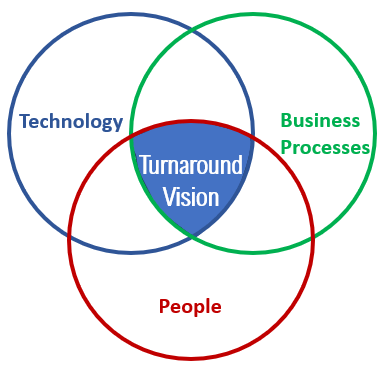
Before implementing an IT-driven turnaround plan, the business must undergo a thorough assessment to understand the depth and scope of the challenges it faces. This assessment is divided into three primary building blocks: business processes, people, and technology.
Business Process Analysis
The first stage examines the company’s business processes. IT solutions often fail when implemented in isolation from process improvements, so a successful turnaround involves aligning new technology with optimized workflows. The business process analysis usually covers operations, customer experiences, and core business areas, for example, supply chain management. The analysis must provide answers to typical questions.
Operational Efficiency: Are processes optimized for speed, accuracy, and cost-effectiveness? Can redundant steps or inefficiencies be eliminated through automation or digitalization?
Customer Experience: How well is the company reaching its customers? Are there bottlenecks in the customer journey that could be improved through better technology or streamlined processes?
Supply Chain Management (as an example): Is the supply chain integrated and data-driven? Where are the bottlenecks causing process disruptions and delays? Can integrated technology platforms help improve visibility, reduce lead times, and mitigate risk?
People and Culture Analysis
The next step is to analyze the company’s workforce and organizational culture. Even the best technology and process improvements will fail without the right people and cultural alignment. This analysis needs to include answers within these areas:
Leadership and Decision-Making: Does the company have the leadership necessary to drive change? Is there a clear vision and buy-in from senior management? Does the middle management understand and support the turnaround plan?
Employee Skills and Engagement: Do employees have the skills to adopt new technologies and processes? Are they engaged and motivated to support the company’s transformation? Do ongoing engagement surveys provide insight into the workforce’s thinking?
Change Management: How well does the organization handle change? How will the resistance to change as a common bottleneck be addressed with the turnaround plan? Does the company invest in OCM teams (Organizational Change Management)?
Technology Assessment
The last step of the evaluation is the analysis of the company’s existing technology infrastructure. Many failing businesses rely on outdated systems – or, in other words, neglect these – that no longer provide functionalities needed by innovative business leaders. Often, they have to wait several months to get a critical functionality implemented. A comprehensive technology assessment provides answers to several key areas:
Hardware and Software: Are the company’s systems (application, OS, network layer) outdated? Is there a lack of integration between critical business functions (e.g., sales, production, supply chain)?
Data Management: Is the company using data effectively to drive informed decisions? Are there opportunities to leverage analytics, AI, or machine learning to gain a competitive advantage? Is there a data layer that could possibly feed these new AI capabilities?
Cybersecurity: Are systems adequately protected against cyber threats? Or is cybersecurity neglected, leaving the companies vulnerable to data breaches and costly system downtime?
Developing the Rescue Plan
Once the analysis phase is concluded, it is time to develop a comprehensive rescue plan, weaving all learnings with a new business strategy. This plan should holistically address all major identified problems, aligning business processes, people, and technology toward the new company vision and goal. The rescue plan must include:
Business Process Reengineering: Business leaders need to optimize and harmonize business processes, eliminate inefficiencies, and eliminate manual process steps by implementing automation and process integration, combining disparate systems, or using data analytics to support decision-makers with real-time data.
Leadership and Workforce Alignment: Developing a leadership team capable of driving change is critical. The OCM component of people management goes a long way. The company must invest in training and development programs to upskill its workforce and create a culture that embraces innovation and continuous improvement.
Technology Upgrades: Based on the technology assessment, the company may need to invest in new hardware, software, or IT services. So, a simple upgrade isn’t appropriate. A digital transformation program must be established, planned, and funded. In other situations, migrating systems from on-premises data centers to the cloud can improve scalability, reduce costs, and free up resources that can focus more on business and planning than on IT maintenance.
Implementation: Putting the Plan in Motion
With the plan in place, executing it is the step at hand. Implementation requires careful planning, resource allocation, and ongoing monitoring to ensure success. It requires an operational leader or program manager who can oversee all workstreams in motion, adapt priorities if needed, and always keep the vision and strategy in mind.
Secure Buy-In from Leadership
The success of any turnaround hinges on strong leadership. The team of business leaders must be fully committed to the transformation. This means they need to be informed as best as possible – there is no form of over-communication. And they must be capable of inspiring confidence across the organization. Also, they need to communicate clearly – and fire on all cylinders – the reasons for change and outline the benefits of the new processes and technologies.
Engage and Train Employees
Employees are the organization’s lifeblood, and their support is essential for the turnaround to succeed. Information–sharing and training programs ensure that all employees understand how to use new technologies and why changes to business processes are being made. Regular communication is vital to keep employees informed and engaged throughout the transformation.
Focus on Quick Wins
While the long-term turnaround plan may take time to implement – sometimes two or three years – it’s essential to identify and prioritize quick wins: small, achievable goals that demonstrate progress early on. Agile program management uses sprints to produce results. Using prototyping allows the workstream leaders to demonstrate the automation of a time-consuming process or the improvement of better customer service interaction. These hands-on experiences are crucial for employees to understand immediate benefits, and they will boost morale and confidence in the plan.
Monitor Progress and Adjust
Turnarounds require ongoing monitoring and flexibility. The business must track key performance indicators (KPIs) to ensure the changes introduced with the action plans deliver the expected results. If progress stalls, program leaders must be willing to make adjustments and continue refining their approach.
Example: Utilizing IT in Manufacturing for R&D Focus
Consider a manufacturing company facing a downturn due to outdated processes and declining competitiveness. By leveraging IT to enhance research and development (R&D) capabilities, the company can position itself for a successful turnaround.
Problem: The company’s R&D team cannot innovate quickly enough to meet changing market demands due to manual, disjointed processes. Competitors are using integrated technologies to bring new products to market faster.
Solution: The company decides to invest in an integrated Product Lifecycle Management (PLM) system that connects all aspects of R&D, from concept and prototyping to production. This system allows the team to collaborate more effectively, access real-time data, and streamline product development cycles. The focus on R&D processes is dominant.
Additionally, the company uses AI-driven analytics to identify emerging trends and guide innovative efforts, helping them stay ahead of the competition.
On the people layer, the researchers and developers come into the focus. They must be enabled to use appropriate technologies to drive ideas and inventions.
Conclusion: The Turnaround Playbook and Outside Help
Turning around a failing business is a complex process that requires a multi-faceted approach. Information Technology plays a critical role in enabling business turnarounds, offering tools and strategies to improve efficiency, streamline operations, and drive innovation. However, technology alone is not enough – and often, within my client base, I saw the hope that IT alone can solve the problems – neglecting business processes and people. Therefore, successful turnarounds require business process reengineering, strong leadership, and an employee culture that supports change.
A vital component of the turnaround playbook is knowing when to seek outside help. External consultants, IT specialists, or turnaround experts can provide valuable insights and expertise that may not be available in-house. Outside help can accelerate the turnaround process by providing fresh perspectives, proven methodologies, and additional highly skilled resources.
Ultimately, turning around a failing business is about creating alignment between processes, people, and technology. With the right plan in place, companies can overcome adversity, regain their competitive edge, and build a foundation for long-term success.
 ERP Strategies
Leave a comment