Organizations today face increasing pressure to modernize their operations. Without a robust Enterprise Resource Planning (ERP) system, critical challenges emerge: limited visibility into manufacturing processes, lack of digital integration, and absence of real-time analytics. Without comprehensive dashboards for monitoring key performance indicators, making informed decisions becomes difficult. This technological gap creates two pressing challenges: maintaining market competitiveness and attracting/retaining skilled employees who expect modern tools and systems in their workplace.
Critical processes still rely heavily on manual execution and individual knowledge. When an experienced worker calls in sick, their replacement often needs hours just to understand basic procedures – creating costly delays and disrupting the entire production flow. This vulnerability in our operations has become a recurring nightmare.
The supply chain clearly needs to evolve beyond its dependence on specific individuals. But when we turn to major consulting firms for solutions, we find ourselves drowning in vague terminology. Terms like ‘Digital Transformation’ sound impressive, but often serve as empty promises – glossy words that mask a lack of practical, actionable solutions.”
One of the biggest hurdles in transforming the supply chain is effectively leveraging the vast data generated in smart factories. Therefore, manufacturers must use advanced analytics and AI to extract actionable insights from operational data. But how?
You need technology as the company’s backbone because new technologies offer immense potential in the data layer with analytics and AI. However, its implementation can be complex, and tailoring software solutions to specific business requirements can be rather costly than using open-source algorithms.
Success in today’s market demands comprehensive digitization, but many leaders feel overwhelmed by the pressure to adopt new technologies. During quarterly meetups, Villanova EMBA alumni often discuss transforming their organizations through technology platforms and streamlined business processes. While this vision of a technology-driven, process-optimized organization sounds appealing, the real challenge lies in practical implementation.
Integrating ERP and Analytics
Integrating your transactional ERP system with analytics capabilities will significantly benefit companies across many industries.
Deeper insights into operations, finances, and supply chains allow real-time decision-making, and your business leaders can identify trends and patterns that may not be apparent from ERP data alone. This will enable enhanced and more accurate demand forecasting and optimized inventory management. Advanced predictive analytics provide more reliable production planning and scheduling.
Real-time performance monitoring allows for tracking KPIs and will quickly identify issues or bottlenecks. Proactive action plans can address these problems. And by using dashboards and visualizations, performance data and progress can be shared across the organization. What gets measured gets improved.
Cost reduction and efficiency gains are measurable after costly implementations, particularly inefficient business processes. In addition, data analytics identifies opportunities for cost savings and additional ways to optimize resource allocation.
Combining ERP and analytics provides enhanced customer insights in a 360-degree view. Customer behavior and preferences can be turned into personalized and improved outreach and service offerings, even more so when combined with the power of AI.
Visibility along the entire supply chain improves supplier performance management and allows for the optimization of inventory levels. It provides logistics and transportation planning toward a more efficient and green use of resources.
An ERP system with state-of-the-art analytical data capabilities enables you to tackle any new (or old) business challenges. But back to the question: “How to get there?”
Mandatory ERP Services
Vision and Strategy
The decision to upgrade your ERP system isn’t just about staying competitive—it’s about preventing further decline. While this investment requires significant financial commitment and time, the greater challenge lies in mobilizing your organization for change. Success demands both resources and resolve: the capital to fund the transformation and the leadership to drive it forward.
First, you need to redo your company vision and set the strategy by collecting data and input. The following actions should come into play:
- Interview your business leaders and key people
- Identify “Big Rocks” by performing an as-is analysis of the business process level
- Allow working sessions to prioritize and rationalize identified Big Rocks
Enterprise Value
As a result, you have data about your organization’s strengths and weaknesses and documented opportunities and threats. This exercise should be enough to update or refresh your organization’s Vision and Mission statements.
Every aspect of transformation—from planning sessions to implementation—comes with both financial and human costs. Resources are finite, and repeated initiatives can drain not just budgets but also team morale and enthusiasm. This reality makes it crucial to clearly define what ‘Enterprise Value’ means for your organization. To guide this definition and ensure your investment delivers meaningful returns, consider the following key questions.
What is your definition of Enterprise Value? Are there any examples that shed more light on “Enterprise Value”?
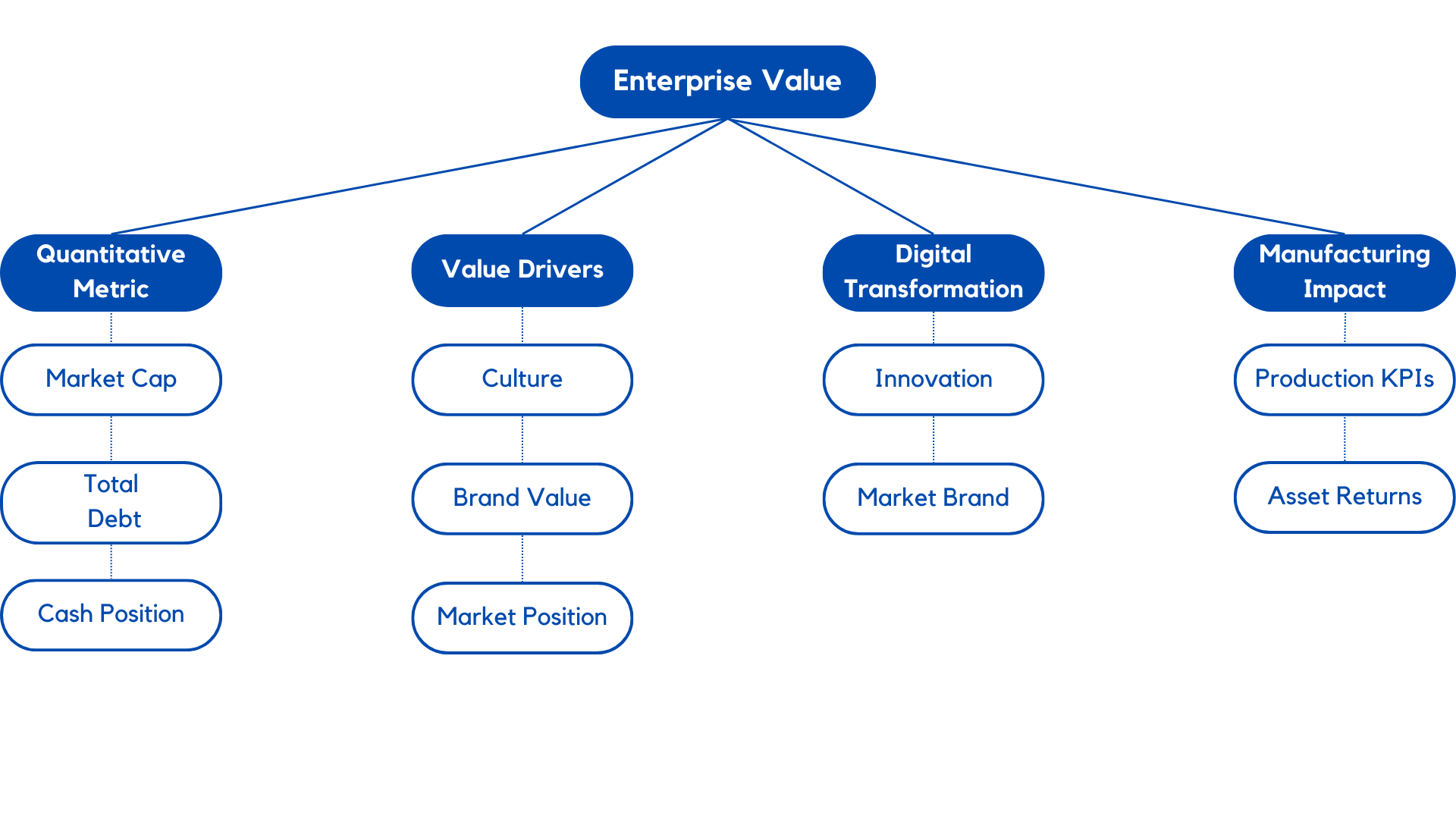
- Name specific components of Enterprise Value.
- To determine Enterprise Value, do you calculate KPIs, such as market capitalization, debt, cash, etc.? If “yes”, how?
- Are there ‘soft factors’ that add value to your company’s overall worth, such as company culture, brand perception, etc.?
- Is Enterprise Value relevant for your company, particularly within your manufacturing Line of Business (LoB)?
- In your understanding, is there a link between “digital transformation” and Enterprise Value?
Business Process Improvements
Manufacturing strategy demands clear choices about your operational future. Do you want to bring back manufacturing to the United States? Do you want to outsource parts of manufacturing to Contract Manufacturers nearby?
What is the core of your business? Are your products top-notch so you can focus more on selling than manufacturing and letting others do the hard work?
Clear and concise answers help to tackle business process improvements:
Cost efficiency: Integrated technology and automation let you operate more efficiently, but is it worth replacing your outdated MES for some of your production lines?
Value creation: Expanding your partner network motivates them to participate and leverage existing client bases. And, of course, boosting your R&D to improve your products will make your client base sticky to your brand – and happier with the product. Data analysis and storytelling have become the center for driving business value and outcome.
State-of-the-art ERP
Your ERP, as the technical backbone, must become the ‘single-source-of-truth.’ It collects all data points across your entire organization, from business process areas and edge systems (for example, Manufacturing Execution Systems or Integrated Business Planning). This data integration allows analytics and forecasting at levels you’ve never seen before.
Reliability and performance: You manufacture in three shifts, so any unplanned downtime of systems or components might cost you hundreds of thousands of dollars. The operations of your IT landscape is an area often outsourced to a service provider, but if not managed correctly, it costs you a lot of money and causes dissatisfaction with your people, your customers, and your partners.
Value-add of Technology: Keeping the IT landscape updated is often a challenge. Technical upgrades alone provide seemingly no value to your business – and, therefore aren’t supported by them. Turn the story around and have them innovate their line of business continuously. You will achieve a triple effect: your business might need features in higher software releases, your customers profit from the innovations, and, as a side effect, your ERP backbone will be up-to-date.
War for Talent
Within the changing manufacturing landscape, the job profiles of workers change from conducting manual tasks to managing and overseeing automated processes. They must understand now how to control robots and apply algorithms (or AI) to situations. Early in the transformation cycle, you must develop an “upskilling” plan for those workers. They might even have to return to school to get acquainted with the new challenges. From a cultural perspective, focus on your committed employees rather than replace them from the outside. There might be a lack of talent anyway. Of course, you can always use contractors, freelancers, or service providers.
Enterprise-wide Process Leader. Aligning technology and process strategies requires people. Therefore, enabling the digital strategy must go hand-in-hand with the leadership for end-to-end business processes, requiring a potential realignment of the leadership layer. These Enterprise Process Owners (EPOs) can rapidly respond to internal and external business needs. Empowered leaders will decide and drive innovation and value creation forward.
Inhouse Skills. Don’t make yourself entirely dependent on ‘outsiders.’ You must attract enough in-house skills for critical management of the external workforce. Typically, service providers exchange their highly experienced consultants after a short period of time, replacing them with newbies. External people shouldn’t make decisions within your company. Therefore, these workforce changes must be planned strategically.
Getting Started with the ERP Roadmap
Start with an internal consulting approach. A few face-to-face meetings should produce a tangible Action Plan with identified problems, first solution proposals, analytical insight into threats from the outside, and significant opportunities. This Action Plan must include milestones with detailed timelines, an identified workstream structure, and a first draft of a workshop plan, including expected efforts.
In our experience, developing an ERP Roadmap that will realize your Vision and Strategy, Business Process Improvements, Technical Architecture, and Organizational Requirements will be possible after four to eight weeks of concentrated work.
Of course, the length of the preparational workstreams depends on the specific company situation. The availability of critical key resources during the interview and workshop phase will dictate the overall length and size of the service engagement.If you don’t have the bandwidth inside your organization, you can always reach out to Service Providers such as Accenture, PwC, or the boutique firm ERP Strategies LLC.
 ERP Strategies
Leave a comment