
Strategic ERP Roadmap: A Real-World Digital Transformation Case Study
This blog presents a real-world ERP Roadmap example from a 2023 consulting engagement with a global biotech company. The company’s mission focuses on improving patient lives through innovative treatments. However, their rapid organic growth and multiple acquisitions pushed their ERP systems to maximum capacity, creating operational challenges.
Current ERP Landscape: Understanding the Multi-System Challenge
The company’s IT landscape consists of three standalone SAP ERP systems, supported by hundreds of peripheral applications – which I refer to as Edge systems. The SAP environment includes two S/4HANA instances and one ECC 6.0 instance, all running outdated versions across multiple data centers.
The technical fragmentation extends to the business layer, where misaligned processes create unnecessary overhead and duplicate work. This situation became critical after two unplanned system outages, which accelerated plans for a company-wide Digital Transformation centered on consolidating to a single ERP system.
Strategic Drivers for ERP Transformation
A unified ERP strategy delivers two key benefits: First, it creates seamless data flow across the enterprise, enabling comprehensive analytics and insights. Second, it optimizes operations across all business units through standardized processes and systems.
Cost and Innovation Challenges in Multi-ERP Environments
- Maintaining three separate SAP systems requires constant updates and patches, tripling the maintenance workload
- Each technical upgrade demands extensive business resources for testing, yet provides no immediate operational value
- Custom modifications in the SAP systems slow down innovation by extending implementation cycles and requiring extensive business testing
- While SAP continues supporting older releases, it comes at a premium cost through additional maintenance fees
- The ECC 6.0 system faces end-of-life by 2030, creating urgent timeline pressure for transformation
Enterprise-Wide ERP Strategy: Building Global Business Processes
- Consolidating three systems into one enables global process standardization, delivering significant efficiency gains across all business units
- A dedicated ERP governance committee must oversee the transformation, with Enterprise Process Owners (EPOs) as key members to ensure business value delivery
- EPOs hold decision-making authority and accountability for specific global processes, such as Account-to-Report (Finance) or Order-to-Cash
- The creation of shared service units will:
- Reduce operating costs
- Eliminate duplicate work
- Provide enterprise-wide performance visibility
Business Benefits of a Single ERP Strategy
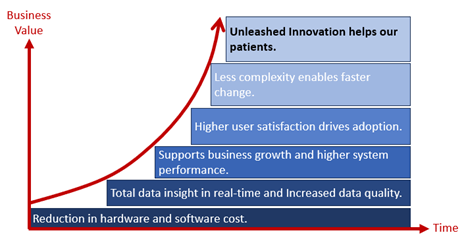
One ERP system compounds business value.
The technical consolidation of all ERP systems combined with state-of-the-art IT operations will significantly increase the ERP’s reliability and performance. A new ERP platform provides the technical foundation for strict governance across functions and business units. A single ERP platform supports the enforcement of global processes.
“One ERP” generates value over time and creates multifold results comparable with compound interest, which increases exponentially over time (see Fig. 1).
Financial Benefits:
- Reduces total cost of ownership (TCO) through:
- Lower hardware and software costs
- Streamlined IT operations expenses
- Eliminated system redundancy
Operational Excellence:
- Enables real-time insights across all core processes
- Improves data quality and reliability
- Creates a scalable platform for growth with no data duplication
- Delivers 100% digitized end-to-end processes, eliminating manual steps
Technology Advantages:
- Provides foundation for AI and Machine Learning initiatives
- Enables faster innovation through continuous upgrades
- Increases user adoption through standardized SAP Fiori interface
Industry-Specific Value:
- Centralizes financial reporting and accounting visibility
- Delivers real-time manufacturing insights across all sites and material flows
Business Benefits of a Single ERP Strategy
Current ERP Architecture Assessment
The system architecture shows three standalone ERP systems at their core. They run on different release levels: two S/4HANA instances and one ECC 6.0 instance. All the release levels are years behind and run within different data centers with various service providers.
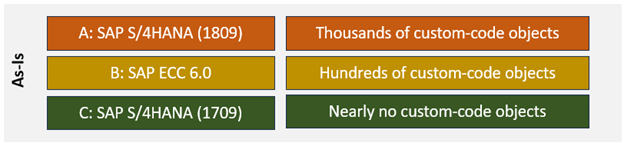
The ERP Architecture has several critical constraints:
- System Lifecycle Management
- Systems A and C reach end-of-life by 2025
- System B faces end-of-maintenance by 2027
- System B support extension possible until 2030, but with premium maintenance fees
- Custom Code Challenges
- System A houses majority of custom-coded objects
- All custom code requires:
- Analysis and potential elimination
- Migration to SAP’s Business Technology Platform (BTP) where necessary
- Extensive testing of replacement functionalities in S/4HANA
- Future-State Requirements
- New “One ERP” must maintain minimal custom code
- System design must support seamless upgrades
- All customizations must align with SAP’s clean core strategy
Strategic Option 1: Greenfield ERP Implementation
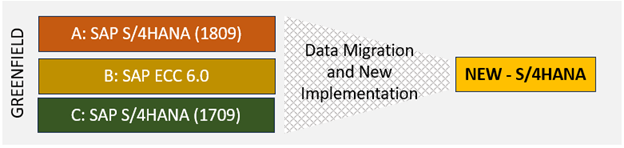
Greenfield software implementation refers to setting up an application, such as ERP, for a new environment. It requires configuration and parametrization from a clean slate with no legacy parts. This approach is used when companies start fresh and without restrictions or dependencies.
Typically, Greenfield implementations take longer as all aspects of the new system must be defined, agreed upon, and implemented. The biggest problem is the time to make decisions: since business leaders have all the options, they spend too much time identifying all the pros and cons.
Additional key characteristics:
Extended Timeline Requirements:
- Lengthy process for global harmonization
- Comprehensive business requirements analysis
- Multiple rounds of stakeholder alignment
Resource Commitments:
- Significant involvement needed from all business units
- Dedicated teams required for implementation
- Sustained engagement from global stakeholders
Parallel System Management:
- Existing systems require ongoing upgrades
- Full IT operations support needed for 5+ years
- Maintenance of both old and new environments
Strategic Option 2: Brownfield ERP Migration
The Brownfield approach describes the technical upgrade of an existing system. Sometimes, it includes a conversion, particularly if the actual software release and the new target release use different architectures. An example is the move from Sap ECC 6.0 to S/4HANA. While the ECC is built on a relational database, S/4HANA uses a columnar database. This change in database architecture enables faster analytics and real-time reporting capabilities.
The Brownfield approach is typically the fastest way to reach a higher release. However, no new functionalities will be enabled during the technical upgrade. The business people, however, need to test the upgraded system. It’s a lot of time commitment with no value added. Sometimes, you hear the terms ‘lift and shift’ to describe this situation.

Figure 4: Brownfield Implementation.
Fig. 4 shows a multiphase roadmap that upgrades systems A and C and converts system B from ECC to S/4HANA. In the second phase, system A is picked as the “One ERP,” and the data from systems B and C are migrated into it. Some configuration settings from systems B and C must also be migrated.
Additional key characteristics:
Delayed Value Realization
- No immediate business benefits
- S/4HANA features require separate implementation
- Additional time needed for testing new functionalities
Parallel Systems Operation
- Extended period of running multiple systems
- Increased operational costs and complexity
- Higher maintenance requirements
- Additional risk management needed
Custom Code Management
- Time-intensive remediation process
- Repeated effort required for future upgrades
- Does not achieve Clean Core objective
- Technical debt carries forward
Strategic Option 3: Global Template with Clean Core
The “Global Template 1” approach takes one of the actual systems, upgrades it, and uses it as the new “One ERP.” The systems with heavy custom code usage are merged onto the new template. This approach is being done in two phases. First, only the system’s configurations and parametrizations are merged. Second, once the functionality merges, the data is loaded into the “One ERP” from all three source systems.
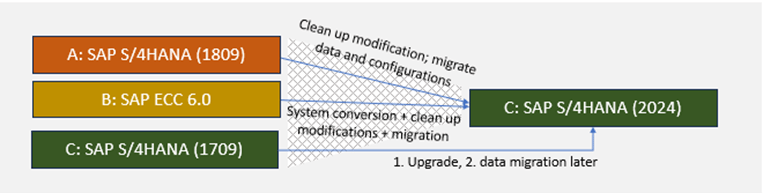
The Global Template 1 option takes the system with the least custom-code objects in our scenario system C.
Additional key characteristics:
Clean Core Foundation
- Already operates without custom modifications
- Provides proven, standardized functionality
- Reduces technical complexity from start
Established Best Practices
- Documented IT processes
- Standardized business procedures
- Auditable system controls
- Validated operational workflows
Phased Migration Path
- Structured approach to data migration
- Systematic transfer of configurations
- Gradual integration of systems A and B
- Risk-managed transition timeline
Strategic Option 4: Enterprise-Scale Template Approach
The “Global Template 2” approach takes the system of the largest and most complex business unit (i.e., system A) as the foundational platform, upgrades it, and creates a shell without data. In a focused phase 1, all custom-code objects are identified and either eliminated or re-implemented on BTP. In phase 2, configurations and parametrizations are merged and consolidated. Finally, with the data migration from systems A, B, and C, the final testing phase approaches.
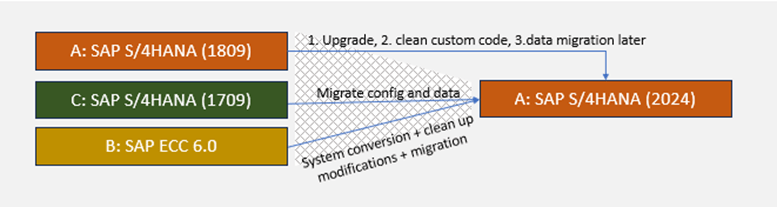
Key characteristics:
Foundation Selection
- System A designated as “One ERP” base
- Preserves complex business capabilities
- Leverages largest operation’s scale
Code Optimization
- Full custom code inventory and analysis
- Systematic modification removal
- Critical customizations moved to BTP
- Clean core establishment
Best Practice Integration
- Adoption of System C’s proven processes
- Implementation of standard procedures
- Transfer of documented controls
- Harmonization of business workflows
ERP Roadmap Success Factors: Key Implementation Considerations
A well-executed ERP roadmap delivers clear direction toward a unified system, but success depends on careful evaluation of options against company-specific needs, strategic budget allocation across multiple years, and sustained commitment to transformation goals. The resulting “One ERP” platform enables annual upgrades and provides continuous access to the latest functionalities, while significantly reducing infrastructure costs through data center consolidation and lower total cost of ownership (TCO).
Beyond technical advantages, the transformation delivers substantial business value. Organizations gain seamless integration across business units, enhanced visibility into enterprise-wide data, and strengthened governance of global processes. This standardization of operations not only improves efficiency but also creates a foundation for future growth and innovation. The investment in “One ERP” ultimately delivers both immediate operational benefits and long-term strategic advantages that compound over time.
 ERP Strategies
Leave a comment