
Building Your ERP Strategy Roadmap
The truth about enterprise data transformation isn’t what most executives expect. While many see it as a purely technical undertaking, the reality is far more strategic – and urgent. According to recent studies, over 70% of ERP implementations fail to deliver anticipated benefits, and the projects are on average 178% over budget, take 2.5 times longer than intended and deliver only 30% of promised benefits.
The Hidden Complexity of Enterprise Data
Think about your enterprise data for a moment. Like many organizations, you probably have data scattered across various systems, departments, and even countries. I recently encountered a senior technology executive, Tim, who faced this exact challenge at a major coffee chain. When the purchasing lead requested consolidated data about coffee bean farmers, what seemed like a simple query turned into a complex data hunting expedition.
The Data Challenge in Numbers:
Recent industry research reveals concerning statistics about ERP implementations. A striking 65% of executives express serious concerns about ERP systems potentially harming their businesses rather than helping them. This skepticism stems from past experiences where complex implementations have disrupted operations and strained resources. Even more troubling is that only 20% of companies achieve more than half of their projected ERP benefits, highlighting a significant gap between expectations and reality. This shortfall often results from inadequate data preparation and migration strategies.

Why Traditional ERP Strategy Falls Short
Here’s what many ERP strategy roadmaps miss: data isn’t just a part of your digital transformation – it’s the foundation. Consider these critical factors:
Data Quality and Integration
- Too many ERP Systems: The complexity of modern enterprise architecture is evident in the numbers. Most organizations we work with operate an average of three or more standalone ERP systems, each serving different business units or geographical regions.
- Data Fragmentation: 70-90% of data in legacy systems is historical and rarely accessed, yet companies continue to maintain and pay for this storage.This fragmentation creates significant challenges for data consistency and real-time reporting
- Integration: Organizations can achieve 50% shorter migration times through proper data reduction. Up to 80% TCO savings possible with strategic data management
Cost of Inaction
- Data Silos: The price of delaying data transformation extends far beyond immediate operational inefficiencies. Just as Tim discovered in the coffee chain, growing data silos create invisible barriers between teams that should be collaborating. In one striking example, a global manufacturing firm found that their European and Asian divisions were making redundant purchases from the same suppliers at different price points, simply because their data wasn’t integrated.
- Manual consolidation: like those Tim’s team initially struggled with, aren’t just time-consuming—they’re dangerous. Studies show that manual data handling increases error rates by 25-40%, with each error potentially cascading through the entire organization. One healthcare provider learned this the hard way when misaligned inventory data led to critical supply shortages across multiple facilities.
- Automation Displacement: the World Economic Forum projects that 85 million jobs could be displaced by automation and AI by 2025. However, this same technological shift is expected to create 97 million new roles. Organizations that fail to transform their data infrastructure now risk falling behind in this massive workforce transition, lacking the foundational capabilities needed to embrace these emerging opportunities.
Competitive Disadvantages
- Missing out on improved profits: The gap between data-driven organizations and their competitors continues to widen at an alarming pace. Recent McKinsey research shows that companies with integrated data systems demonstrate 2-5% higher EBITDA than their peers—a difference that can translate into millions in additional profit for mid-sized enterprises. Consider the case of a regional retailer who, after integrating their point-of-sale data with inventory management, saw their profit margins increase by 3.2% within the first year alone.
- Lack of real-time data: The impact of real-time data access is even more dramatic. Organizations leveraging integrated data systems have reduced their order fulfillment times by 50-70%, creating a significant competitive advantage in customer satisfaction. Tim’s coffee chain exemplifies this transformation: after implementing real-time inventory tracking across their stores, they reduced stockouts by 45% and improved customer satisfaction scores by 28%. In contrast, their competitors still struggled with daily manual inventory counts and delayed restocking decisions.
- Missing out on AI-driven analytics: Perhaps most compelling is the power of AI-driven analytics in modern business operations. With properly integrated data systems, organizations are improving their forecast accuracy by 20-30%, leading to optimized inventory levels and reduced carrying costs. One global consumer goods company leveraged their integrated data platform to predict seasonal demand variations with 92% accuracy, resulting in a 15% reduction in excess inventory costs. Meanwhile, competitors relying on traditional forecasting methods continued to struggle with overstock and stockout situations, particularly during peak seasons.
These aren’t just statistics—they represent the growing divide between organizations that have embraced data transformation and those still relying on fragmented, legacy approaches. As Tim discovered, the competitive implications of postponing data integration extend far beyond operational efficiency; they directly impact market share, customer loyalty, and ultimately, business survival in an increasingly data-driven marketplace.
Building Your Data-First ERP Strategy Roadmap
The path forward requires a fundamental shift in how we approach ERP strategy, moving beyond traditional system-centric thinking to a data-first mindset. As Tim discovered during his coffee chain transformation, success lies not in the technology itself, but in how effectively organizations capture, manage, and leverage their data assets. Here’s your value-driven roadmap, backed by real-world implementation successes:
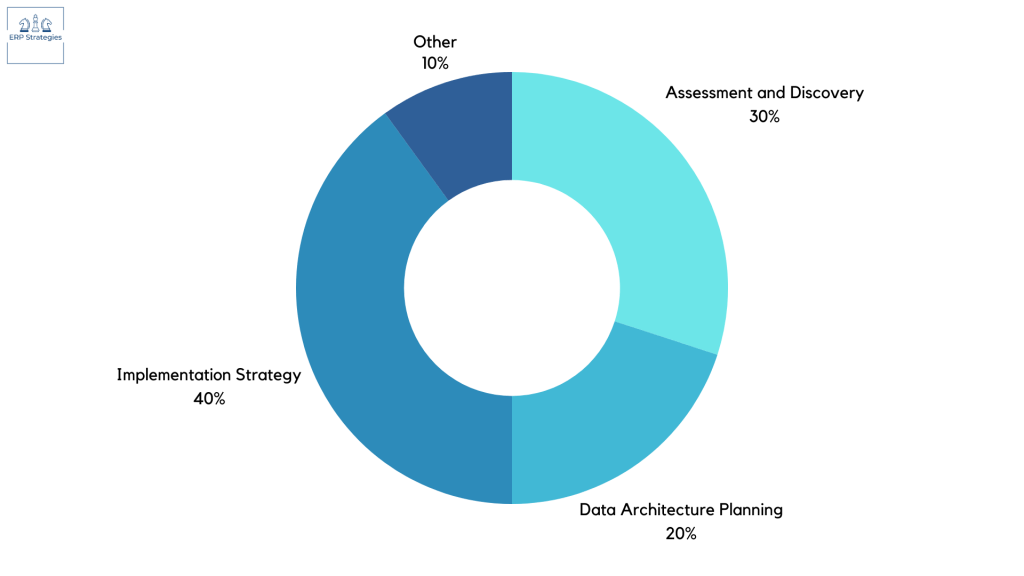
Assessment and Discovery (20-30% of total value)
The foundation of any successful transformation begins with a comprehensive understanding of your current data landscape. A global manufacturing firm recently undertook this exercise and uncovered over 150 redundant data processes, representing millions in potential savings. Your assessment should:
- Map data sources and flows across all business units, identifying key integration points and bottlenecks
- Document manual processes that could be automated – one healthcare provider found 40% of their staff time was spent on redundant data entry
- Evaluate data quality and consistency using standardized metrics and scoring frameworks
- Target 80% out-of-box functionality to maximize ROI, reducing costly customizations that often plague ERP implementations
Data Architecture Planning (10-20% of total value)
With a clear understanding of your current state, the next phase focuses on designing a future-proof data architecture. Tim’s team spent six weeks in this phase, establishing the frameworks that would eventually enable their real-time analytics capabilities:
- Define your single source of truth for critical business data – one retailer reduced reporting discrepancies by 95% through this effort
- Establish robust data governance and quality management protocols to ensure long-term data integrity
- Design scalable architectures that can accommodate future AI/ML integration needs
- Aim for 90% reduction in custom code, focusing on standardized processes that can evolve with your business
Implementation Strategy (30-40% of total value)
The execution phase requires careful orchestration of technical and organizational changes. A leading automotive supplier successfully transformed their operations by:
- Prioritizing high-impact areas that deliver quick wins and build organizational momentum
- Implementing comprehensive data migration and cleansing protocols – they achieved 99.9% data accuracy post-migration
- Establishing clear governance frameworks that balance innovation with control
- Targeting 20-35% reduction in transformation costs through efficient process redesign
Value Creation Metrics:
Successful transformations require clear metrics to track and validate progress. Based on benchmarks from over 200 implementations:
- Harmonization (20-30% of total value): Standardizing data definitions and processes across the enterprise
- Standardization (10-20% of total value): Reducing variants in business processes and system customizations
- Innovation (20-30% of total value): Enabling new business capabilities through improved data access
- Differentiation (30-40% of total value): Creating competitive advantages through superior data utilization
This roadmap isn’t just theoretical – it’s proven in practice. When Tim’s team followed this approach, they achieved their transformation goals three months ahead of schedule and 15% under budget. The key lies in maintaining a relentless focus on data quality and business value throughout the journey, rather than getting caught up in technical specifications and system features.“`
The Real-World Impact: From Insight to Action
Let’s return to our coffee chain example for a compelling demonstration of data transformation in action. After understanding his data landscape, Tim initiated a transformation that yielded remarkable results, providing a blueprint for other organizations to follow.
Centralizing Data Sources
Tim’s first major initiative tackled the fragmented data environment that had plagued the coffee chain’s operations. By consolidating data from 2,300 stores across 15 countries into a unified data platform, the company eliminated the weekly 20-hour manual data consolidation process that had previously frustrated their purchasing team. This centralization became the foundation for all subsequent improvements, much like a global retailer who achieved $50 million in annual savings through similar consolidation efforts.
Automating Data Consolidation
The automation of data processes transformed daily operations across the chain. Store managers who once spent 2-3 hours daily manually compiling reports now received automated insights in real-time. This shift mirrored the success of a major restaurant chain that automated 85% of their reporting processes, allowing their managers to spend more time on customer experience and staff development.
Implementing Real-time Analytics
Perhaps the most significant impact came from the implementation of real-time analytics. Store managers could now see live inventory levels, sales patterns, and staffing needs, enabling dynamic adjustments throughout the day. During peak hours, this capability allowed stores to optimize staffing levels and inventory management, similar to how a leading quick-service restaurant chain reduced their waste by 30% through real-time inventory tracking.
Quantifiable Results
The numbers tell a compelling story of transformation:
- Reducing manual data processing by 65% freed up approximately 1,200 hours per week across the organization, allowing staff to focus on higher-value activities
- Improving forecast accuracy by 40% led to optimized inventory levels and reduced waste, saving an estimated $2.3 million annually
- Achieving 99.9% data availability ensured that decision-makers had reliable information at their fingertips, crucial for daily operations and strategic planning
Beyond the Numbers
The transformation’s impact extended beyond operational metrics. Employee satisfaction scores increased by 25% as staff spent less time on manual data entry and more time on customer interaction. Customer experience metrics improved significantly, with a 30% reduction in wait times during peak hours due to better staffing and inventory management.
Unexpected Benefits
The project also yielded unexpected advantages. The improved data visibility enabled the chain to:
- Identify and quickly respond to emerging customer preferences
- Optimize their supply chain by better understanding regional variations in demand
- Deploy successful promotional campaigns based on granular customer behavior analysis
- Reduce environmental impact through better resource management
This real-world example demonstrates how a well-executed data transformation can deliver value across every facet of an organization. As Tim noted, “What started as a solution to our data consolidation challenges evolved into a complete reimagining of how we operate and serve our customers.”
Your Action Plan
Start your data transformation journey with these steps:
Audit Your Current State
- Map your data sources
- Identify critical business processes
- Document manual workflows
- Target 30-40% reduction in data redundancy
Define Your Vision
- Set clear transformation goals
- Align with business objectives
- Plan for future capabilities
- Aim for 80% process automation
Build Your Roadmap
- Prioritize quick wins
- Plan for long-term success
- Establish clear metrics
- Target ROI within 3 years
Looking Ahead
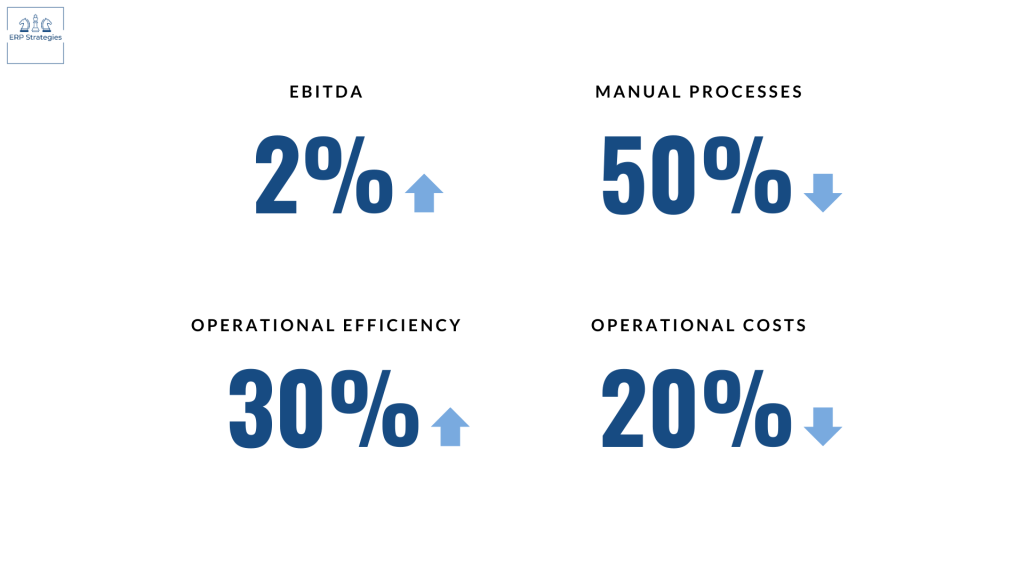
The future of enterprise success lies in data transformation. As you develop your ERP strategy roadmap, remember that data isn’t just an IT concern – it’s a business imperative. Organizations that successfully implement ERP transformations can expect:
- 2% or higher EBITDA improvement
- 50% reduction in manual processes
- 30% improvement in operational efficiency
- 25% reduction in operational costs
Your data transformation journey doesn’t have to be perfect from day one. Start with clear objectives, focus on high-impact areas, and build momentum through visible wins. The key is to begin now, with a clear vision and a solid strategy.
[About Andreas: With over 21 years at SAP as the Senior Vice President of Global Support, Andreas led numerous complex transformational programs across North America, Latin America, Europe, and Asia. His leadership and expertise have driven success in highly intricate digital initiatives worldwide. If you’re looking to get started on your strategy journey – schedule your free call with us today!]
 ERP Strategies
Leave a comment