This guide helps Business Professionals to share their wealth of knowledge and experience across their network and beyond. You might reach a point where you wish to engage with a larger audience. Despite the digital era we’re living in, I still value printed books. But how can you follow me into the world of self-publishing?
You may have already tried to contact a traditional publisher, and you may have experienced intimidation, long waiting times, editorial gatekeepers, and no guarantee of success.
This blog outlines what you must do to get your printed book in your hands as a token of reputation.
My Journey.
I always wanted to write a book, but I had no free time or energy because my job as a senior executive at SAP didn’t allow it. This situation changed in 2017 once we parted ways. The first book, published by Springer Nature in 2019, summarized some learnings from customer situations. While the publisher worked with me, the book itself was not a best seller.
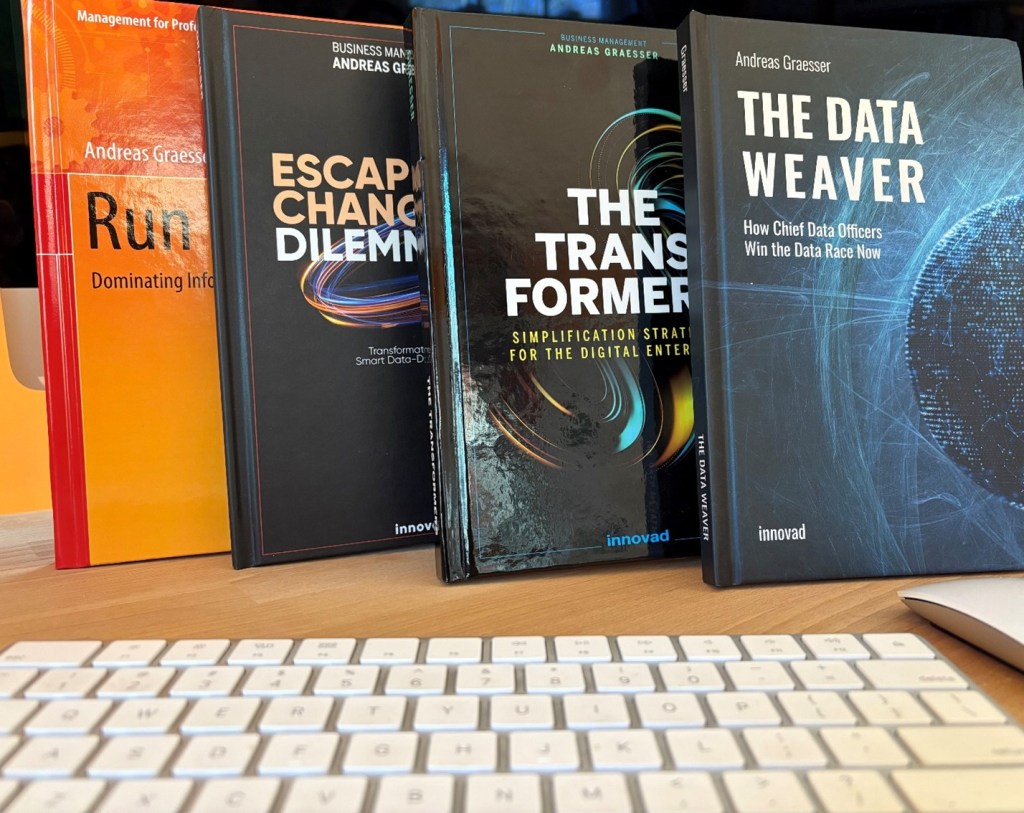
Changing course, I started self-publishing to control the outcome, and in the meantime, I published four more books. What are the watchouts for you?
- Think about the purpose of your book and your audience. Is it knowledge transfer and thought leadership about subject matters, or do you want to share customer stories and experiences? Who do you want to read your book, business analysts, entrepreneurs, managers, or executives?
- The monetization of ideas is always a dominant topic. To set the stage straight, you won’t earn much money from writing and publishing (if at all). BUT: any published book also provides intangible value to the author. Sometimes, I ask myself: Did this person approach me because my books demonstrated a solid reputation for digital transformation? I must admit that there is statistically no correlation.
- Finding a partner for my self-published books was always a priority. Some companies are interested in using my books to demonstrate their thought leadership and amplify their reputation. I partnered with these companies. They committed to buying some books (200, 500, or more), and I committed to including a chapter or two about their product. In addition, I always use digital publishing platforms such as Amazon. However, don’t expect to sell thousands of copies if your book is about a niche topic.
- A well-structured manuscript attracts the eyes of your audience. However, the real challenge is getting your thoughts across and filling the pages so that a reader keeps reading. Using PowerPoint decks and ‘translating’ them to text might not be the best method. And another tip: don’t use Gen AI. There are no shortcuts to writing books.
Conclusion.
I didn’t touch on many aspects of self-publishing here, such as marketing, promotions, editing, proofreading, colored charts and graphs, formatting, font sizes, etc., but I didn’t want to write a book here (😉).
Finally, one piece of advice: design an eye-catching cover. I always focused on the covers of my five books.
 ERP Strategies
Leave a comment