
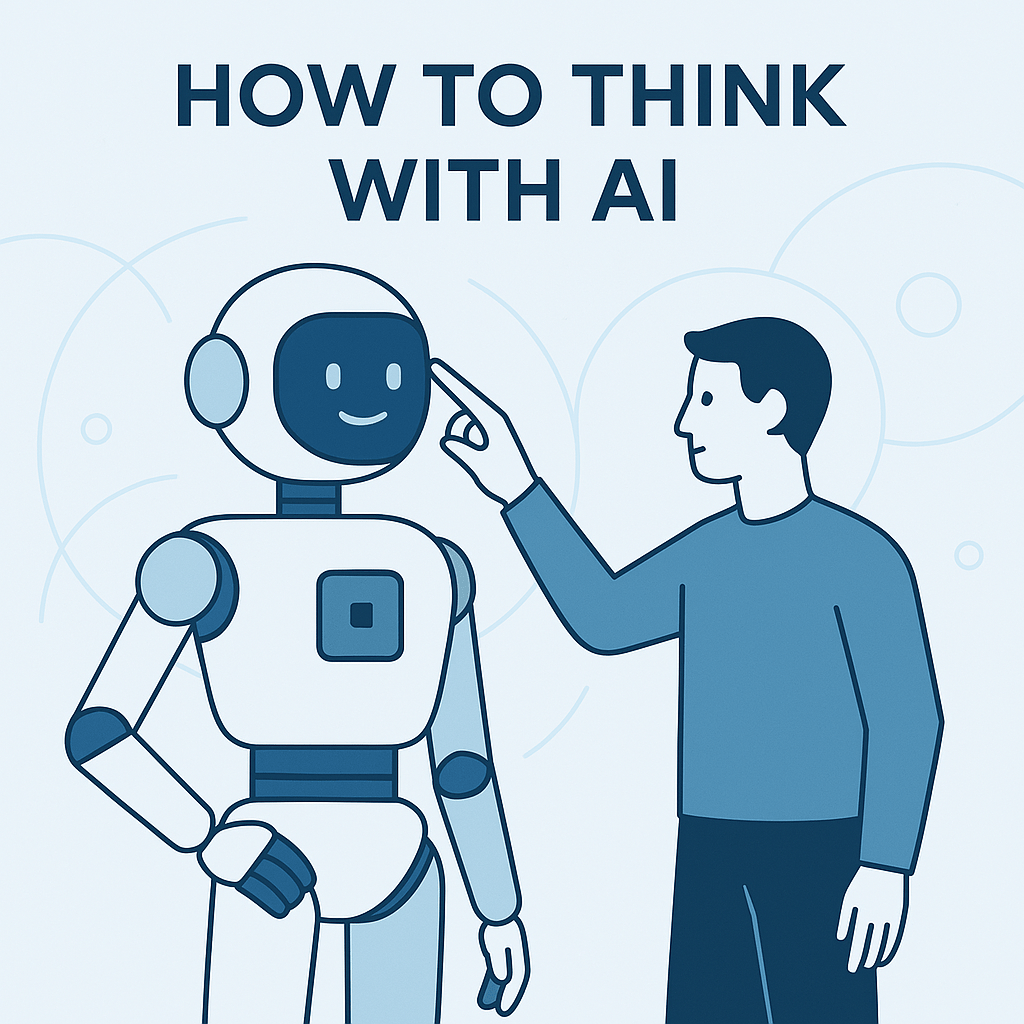
Why the most valuable Six Sigma team member might not be human—and why that should fundamentally reshape how we think about manufacturing.
There is something strange about walking through a modern factory. Automation is undeniable—robot arms glide, sensors blink, machines whisper their numbers into cloud-based dashboards. Yet despite the sophistication, talk to shift leads, Black Belts, or engineers, and you uncover a pervasive truth: operations are still reactive. Manufacturing drowns in data but struggles to quickly answer critical questions—”Why is defect rate up 2% this week? What changed last quarter?”
A mismatch exists between problems and the tools designed to solve them. A new tool is changing this paradigm—not built from logic gates or ladder logic but autonomous reasoning and goal-oriented decision-making. This tool isn’t human—it has an API key.
Agentic AI: The New Black Belt
Manufacturing innovation has always revolved around incremental abstraction—from human hands to machines, from machines to programmable logic controllers, from PLCs to MES systems, and ultimately from MES systems to cloud-based dashboards. Through each leap, the core epistemology of manufacturing remained unchanged: linear causality, observational troubleshooting, and statistical inference dominated our methodologies.
AI agents, a group of workflows that help automate processes is what I refer to as Agentic AI.
Agentic AI shifts the epistemology of Six Sigma by introducing autonomous, self-learning systems capable of independently analyzing situations, making decisions, and adapting strategies over time without constant human oversight.
Consider traditional Six Sigma teams combing through logs for weeks versus Agentic AI quickly narrating, “Most defects trace to Machine 14 post-maintenance, third shift, calibration offset.”
Agentic AI understands context, analyzes data autonomously, and reasons continuously. It isn’t simply a tool for answering queries; it’s a full-stack autonomous analyst fluent in DMAIC, Snowflake, MES, and domain-specific knowledge.
Embedding Agentic AI within DMAIC
Define: Precision Problem Framing
Poorly defined problems doom many improvement initiatives. Agentic AI autonomously synthesizes thousands of customer complaints, warranty records, and internal audits into clear, actionable definitions:
- Prompt: “Summarize recurring issues in pump seal failures.”
- AI Response: “72% of failures occur within 30 days post-installation, primarily on Line 4 during colder temperatures.”
This sharpens problem scope dramatically, enabling precise action from the outset.
Measure: Transforming Chaos into Clarity
Agentic AI excels at bringing order to chaotic datasets. It autonomously evaluates measurement systems, identifies inefficiencies, and refines data collection methods:
- Prompt: “Assess the measurement strategy for torque verification.”
- AI Response: “Current sample size inadequate for confidence level; Gage R&R exceeds acceptable variance—recommend sensor recalibration.”
Such immediate analytical feedback can save weeks of manual analysis.
Analyze: Autonomous Inductive Reasoning
This phase is often a bottleneck, bogged down by manual hypothesis generation. Agentic AI autonomously identifies critical patterns and generates insightful hypotheses:
- Prompt: “Analyze recent scrap trends in spindle bearings.”
- AI Response: “Increased scrap correlates with recent supplier change and higher torque variance from outdated PLC profiles.”
By autonomously connecting dots, AI highlights pathways to actionable insights that human teams might overlook.
Improve: Historical Insights, Practical Solutions
Agentic AI doesn’t just suggest improvements; it autonomously references historical data and proposes precise, tested solutions:
- Root Cause: Incorrect torque profiles.
- Countermeasure: Recalibrate tooling, update PLC software.
- Owner: Maintenance Supervisor.
- Validation: Trial run with SPC monitoring.
These clear, detailed recommendations empower rapid decision-making and implementation.
Control: Autonomous Institutional Memory
Traditionally, gains from improvement initiatives fade due to inadequate follow-up. Agentic AI autonomously monitors operational data, proactively flags regressions, and provides continuous oversight:
- Prompt: “Identify early indicators of recurring scrap issues.”
- AI Response: “Minor increase in scrap observed; tool calibration schedule lapses due to staffing constraints.”
This ensures sustained improvements rather than temporary fixes.
But I’m sure the thought remains, how do I even build this?
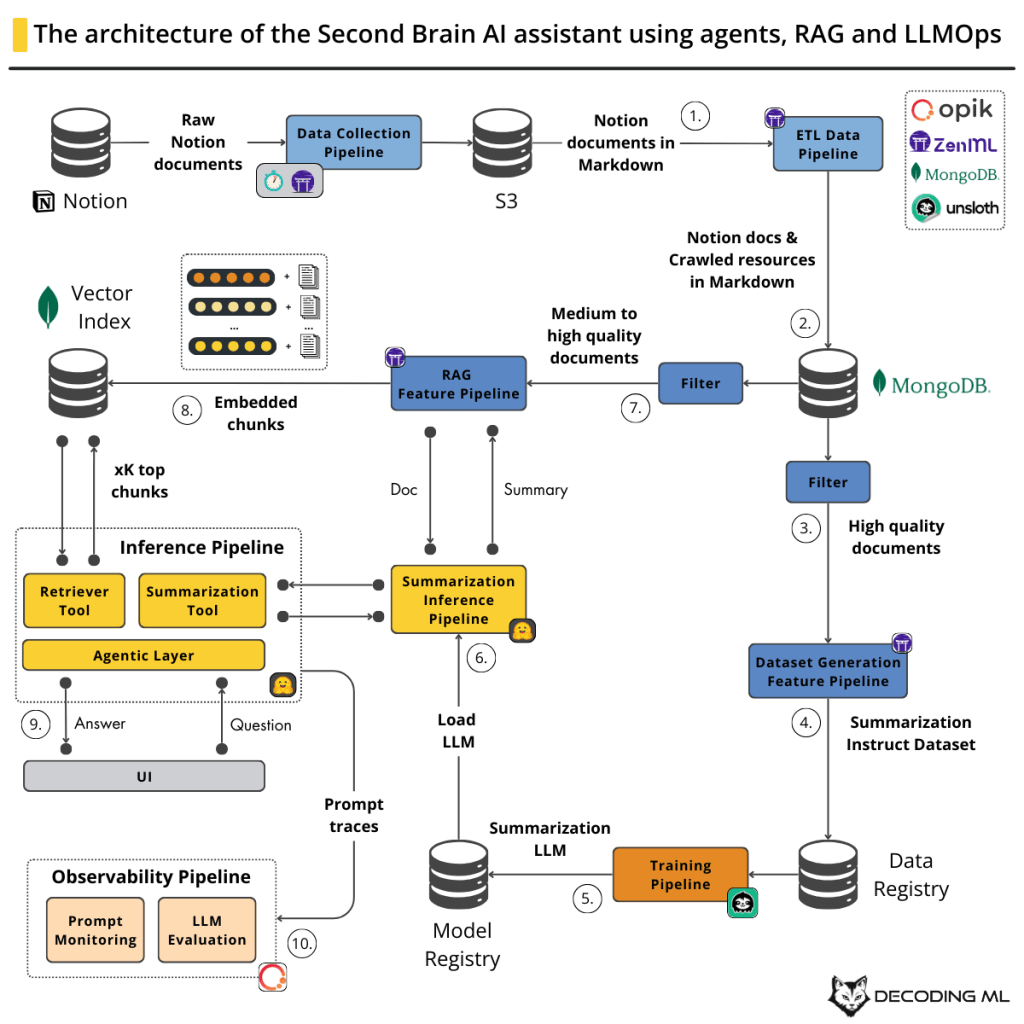
Building a Second Brain with RAG and AI Agents
Agentic AI transcends manufacturing applications. It encapsulates a broader evolution in our interaction with AI systems, epitomized by the concept of a “Second Brain”—an external, AI-driven cognitive companion designed to augment human cognition.
Retrieval-Augmented Generation (RAG)
RAG systems dynamically retrieve relevant information from extensive personal knowledge bases. This enables instant document summarization, intelligent resource recommendations, and highly contextual insights, fundamentally reshaping personal and organizational knowledge management.
Developing Your Second Brain AI
- Setup the Environment: Leverage powerful tools such as LangChain, MindsDB, MongoDB, ZenML, Hugging Face, and Comet.
- Data Source Integration: Connect seamlessly to platforms like Notion, Google Drive, and enterprise databases.
- Designing Agentic Architectures: Create sophisticated AI architectures capable of autonomous reasoning and proactive decision-making.
- Model Deployment and Optimization: Deploy and fine-tune models customized for specific operational contexts and challenges.
- Interactive User Interface: Implement intuitive front-end applications with frameworks like React or Vue.js, enhanced by interactive visualizations.
- Continuous Improvement: Iteratively refine your AI systems based on real-world feedback loops, enhancing performance autonomously over time.
What’s Actually Changing Here?
This isn’t about technology. It’s about epistemology.
We’ve spent decades training people to think in fishbone diagrams and control charts—and those tools still matter. But Ai agents think in narratives. It reasons from partial evidence. It integrates data that never fit cleanly into columns.
And in doing so, it challenges the foundational assumption of Six Sigma: that the only valid improvement method is statistical analysis by certified experts.
Now, the expertise is embedded in the model. The certification? Implicit in the training data and fine-tuning.
This does not make Six Sigma obsolete. It makes it accessible.
Ai agents lets junior analysts do the work of senior engineers—not by faking it, but by guiding them. It lets a maintenance tech co-author an RCA report. It lets a line lead ask a why—and get a real answer.
That’s not just democratization. That’s survival. Because most manufacturers don’t have enough Black Belts. And they never will.
So, What Should You Actually Do?
This isn’t a call to go “AI-first.” It’s a call to stop being AI-last.
If you run operations, start by identifying your biggest process improvement bottlenecks:
- Is it defining problems across teams?
- Is it analyzing unstructured failure data?
- Is it writing SOPs and training docs?
- Is it detecting recurrence before it’s visible on a control chart?
Pick one. Pilot AI Agents there.
Give your team access. Watch how they interact with it. Notice what it short-circuits. Listen to the conversations that happen when a machine tells the same story your gut already suspected—but couldn’t prove.
Then scale.
Need help with that? Give us a call!
The AI Factory Revolution
There’s a strange tension here. On one hand, you are embedding intelligence into your operations in a way that feels magical. On the other hand, you are committing to a new kind of dependence—on a machine that interprets the world differently than you.
That’s not something to take lightly.
But if your factory is already built on abstractions—sensors, databases, ERPs—then this is just the next abstraction.
It’s just the first one that talks back.
The choice isn’t whether to use generative AI. The choice is whether you want to keep guessing at problems while your competitors get real answers faster.
Six Sigma gave us the roadmap. AI is giving us the engine.
The factory of the future won’t be built. It will be debugged—conversationally.
 ERP Strategies
Leave a comment